Blog Image

Blog Image

Sunday, May 10, 2020

Life, Grandmita, and Wiffle Ball

Today, during Mother's Day, I am fondly remembering my maternal grandmother, Grandmita. I recall many memories of Grandmita and the lessons I learned from her life and example. One such lesson occurred after a particularly awful game of wiffle ball when I was ten years old.

Many summer days of my childhood were spent at Grandmita's house. Inevitably, my brothers and cousins always wound up playing wiffle ball in her backyard. Even though I was more interested in raiding the candy jar in Grandmita's kitchen, I begrudgingly ended up in the game.

Playing sports with my cousins and brothers was a painful experience. They were such good athletes. And I was not. Imagine playing ball against the likes of Mickey Mantle or Willie Mays while you could barely muster the athletic prowess of Fatty Arbuckle. That was my wiffle ball hell every day of that summer.


Really and truly, I was a terrible athlete. With no word of exaggeration, during one particular game, I struck out at least ten times. And I dropped just as many fly balls in the outfield. Disheartened, bored, and hungry, I quit the game by the fifth inning and trudged inside Grandmita's house. Yet, Grandmita always knew when I was upset. Moms and grandmas seem to have that gift.

Grandmita followed me into the room and tried to console me. She never wanted to see anybody feel excluded or left out. Grandmita offered words of compassion. She encouraged me to go out and try again. And when neither tactic work, she grabbed me by the hand and dragged me back outside to continue the game.

Did I suddenly become good at wiffle ball? No. Would I grow up to become a star athlete from that moment on? Absolutely not. So why was this such a memorable and formative moment for me?

Seared in my mind and heart is the way in which Grandmita was present to me. Grandmita was aware when one of her beloved grandchildren was feeling like a real loser, a real outsider. She sought me out, offering words of care, encouragement, and positivity. And when I needed it, Grandmita led me back to the yard with equal parts confidence and firmness.

If I can be attentive to others with such care, then I will have learned an invaluable lesson from Grandmita. If I can speak words of comfort when others are feeling down, then Grandmita's example was not in vain. If I can return time and again to those challenging games that occur throughout life, or if I can lead others back to face their own struggles, then I certainly will have followed Grandmita's lead. I can only hope that I possess a fraction of the goodness and love of Grandmita.

Who knew such life lessons could've been learned on and off the wiffle ball diamond?

Sunday, April 26, 2020

Jesus Amidst Diapers

Yes. You read that title correctly. In recent days, I have discovered Jesus amidst diapers.

Let me try to explain.

A young mother reached out to one of our parishioners. Although her family was getting by with food, they were really feeling the pinch with diapers. There simply were not enough resources to buy anymore diapers. Apparently, even cheap diapers are expensive. This woman was hoping that this parishioner might know somebody who could help her with this impending crisis.

This parishioner then made a few calls and sent several messages to other members of the parish: Did anybody have extra diapers? If anybody was shopping, might they pick up some diapers? Could anybody donate a few dollars towards diapers?

Within the span of a few hours, the young mother was swamped with knocks on the door and calls on her phone. Anonymous packages of diapers lined her porch and gift cards filled her mailbox.

The young mother called the parishioner she initially reached out to and was overjoyed. She cried, so appreciative was she of the generosity shown to her by so many strangers.

You see, Jesus was there, amidst the diapers. When there was a need within the community, many disciples of Jesus responded to the call.

Selflessly, they gave, even when they themselves had very little resources. Some "masked up" and trudged to the store. Others drove across town to deliver the boxes. These Christians simply were following the lead of their Master. They responded with generosity and love. They are the salt and light of the world.

As followers of Jesus Christ, we seek to serve the needs of others - in big ways and small. If we are willing to sacrifice in love for others, we will get through this current storm. Together, as the Body of Christ, we will lift each other up in support.

We'll even find Jesus amidst diapers.

Sunday, April 12, 2020

Return to Galilee

Interestingly, in the account of the resurrection of Jesus that we hear proclaimed in the Gospel of Matthew, both the angel and the Risen Jesus urge Magdelena and Mary to share this message with the disciples: "Do not be afraid. Return to Galilee. There, you will see the Risen Lord."

What is the significance of Galilee? Why must the disciples go back after the events of the Lord's crucifixion, death, and resurrection in Jerusalem?

As Pope Francis reflects on this passage, he reminds us that the return to Galilee means going back to that place where Jesus first encountered us. The return to Galilee is to go back to that initial joy when Jesus first called us by name and we responded to this summons.

Yet, when we return to Galilee after some time, much like the disciples, we will also carry within us the scars of life. The disciples were fearful. Their faith had wavered. Uncertainty still lingered. The same is true for us. When we return to Galilee again and again, we are not always the same people as we were when Jesus first invited us to follow him at the lakeside. We hold within us life's shadows and disappointments, as well as our own failures and struggles.

Still, Jesus beckons us back to Galilee. When we return to Galilee, when we seek out Jesus again, we will be able to see our life in a new light. We need not be afraid. Darkness and death do not have the final word. Rather, the Risen Christ will transform us. The call to follow him and to be his disciple will deepen and increase. The meaning of our complex lives will start to come into focus.

The return to Galilee is a journey of faith. We go back to Jesus to be cured, to be forgiven, and to be called once more. We go back to Galilee to be renewed. And from Galilee, with Jesus at our side, we go forth to share the good news with others, inviting them to let go of fear and to return to Galilee.

There, in Galilee, we will always encounter anew the Risen Lord Jesus.

Friday, April 10, 2020

Hail the Cross!

During my college studies, I attended schools that were sponsored by the Congregation of Holy Cross. The religious priests and brothers of this congregation bring hope to their centers of education, parish life, and missionary work. This is symbolized by the cross and anchors that emblazon signs and buildings, as well as the medallions worn by these hope-filled men.

Most telling is the motto of the Congregation of Holy Cross. Beneath the cross and anchors appears in Latin, "Ave Crux, Spes Unica." That is, "Hail the Cross, Our Only Hope."

On this Good Friday, all of us can once more make these words our own. "Hail the Cross, Our Only Hope." On this sacred and solemn day, we remember the profound fidelity of Jesus to his mission. We commemorate the love that drove Jesus to confront the powers of death which oppose life and goodness. Jesus carries the sins of the world and reverses the fate of sinners. The Cross is the symbol of the victory of mercy.

Yet, if we are to follow the Cross of Christ, if we are to proclaim "Ave Crux, Spes Unica," then we must also realize that we cannot place our hope in anything else.

The Jewish religious leaders condemned one of their own. Likewise, in our own day, our religious institutions at times have gravely failed us. The governor Pontius Pilate acted unjustly and with fear by sentencing Jesus to death. So too do we see the political leaders and governments of our time failing to lead. The Roman soldiers tortured the innocent man. This impulse to violence and power is readily seen in ourselves and within our own society. Judas the Iscariot betrayed Jesus; Peter denied him.  All abandoned him, except Mary of Cleopas, Magdalena, and his mother. Certainly, we also know full well the sting of betrayal, hurt, abandonment, and disappointments in our own lives.

Only the Cross of Christ can bring us true hope. In the Cross, we encounter the most selfless gift of love. In the Cross, we see God's solidarity with our own weakness and suffering. In the Cross, we experience the promise of eternal newness and life.

This is a day of hope. Despite the currents of fear, anxiety, and death, we look to the Cross as our sign of hope... indeed, our only hope. No longer can we place our hope in the passing things of this world. Rather, we look to those which endure. We look to the love of God in Jesus that is faithful to the end. So with faith and confidence, let us sing and shout: "Ave Crux, Spes Unica!" "Hail the Cross, Our Only Hope!"

Thursday, April 9, 2020

We are Priests and Eucharist

Each year on Holy Thursday, we commemorate two incredible gifts that God has given to us in the Christian life: the ordained priesthood and the Eucharist. 

Priests are called to be like Christ the Servant. As ordained ministers, we are summoned to wash the feet of others, to serve with humility, and to be God's abundant mercy. Priests pray with, for, and on behalf of God's People. Ordained priests also serve by celebrating the sacraments, with special devotion to the Eucharist.

The Eucharist is indeed the source and summit of the Christian life. In the Eucharist, we receive the very Body and Blood of Jesus Christ. In this sacrifice, we experience forgiveness and reconciliation with God. In this memorial, we remember the selfless love of Christ. In this sacrament, we continuously become united as one with the Lord.

It is very heartbreaking, then, that we cannot currently gather together as the Church in order to celebrate these two gifts of priesthood and Eucharist on this Holy Thursday.

Yet, we believe God can always transform moments of darkness into light. Perhaps God is using this time to remind all of us something fundamental about our own Christian identities: all of us are priests; all of us are Eucharist.

By virtue of our baptism, we have become a "chosen race, a royal priesthood, a people set apart." As royal priests of Christ, each of us prays for the needs of our families, our Church, and our world. We offer our way of life - whether single, married, parent, ordained, or widowed - as an acceptable offering to God. We sacrifice for others. We serve the needs of all by washing their feet. 

And like the bread that is offered on the altar, we are also broken and blessed. Like the wine, we are poured out and shared. If we follow Jesus the Lord with integrity and authenticity, others will then look to us and be fortified by our example. They can feed upon our living relationship with the Lord. They can drink in our words of faith and hope. In turn, we are strengthened for mission by other disciples, who with us, form the Body of Christ.


Certainly, we look forward to the day when we can all be reunited at the altar where we will praise God with great joy for the gifts of the ordained priesthood and the Eucharist. As that glorious day approaches, let us also continue to grow in our own baptismal identity. We use this time to remember that in Christ Jesus, we are priests and Eucharist.

Wednesday, April 8, 2020

Taize Prayer

At different chapters of our lives, we are drawn to certain expressions of prayer. During my college years, I was drawn to the Taizé Prayer services that were held periodically at our college chapel.

Taizé Prayer is very contemplative. The prayer space is surrounded by candlelight and sacred images. Taizé uses simple melodies and chants, often verses from psalms or spiritual writings. There is no presider or leader. No sermons or homilies. No ritual, other than continual singing.

The idea behind this style of prayer is that all Christians can join in heart and voice, collectively meditating on the love and mercy of God. Brother Roger founded the ecumenical community of monks in Taizé, France during World War II. Brother Roger especially desired to gather people of all different backgrounds to pray together as a living sign that the peace of Christ is still present whenever we gather in faith.

In the midst of this current disaster of the COVID-19 pandemic, perhaps it is worthwhile to re-visit (or perhaps for some of us, to try for the first time) this way of prayer. Because we are all stuck in our homes, some elements will have to be improvised.

First, create a Taizé playlist. Here are some possible suggestions:

"O Lord, Hear My Prayer"

"Stay With Me"

"Jesus, Remember Me"

"Bless the Lord, My Soul"


Next, establish a sacred space. Gather some sacred images and a cross. Also, light some candles. Sit in a comfortable position, whether in a chair or on the floor. Now play the music.

Finally, enter into the prayer. Allow the words to become your own. Perhaps join in the singing. End your prayer experience in silence.

What has the Lord been speaking to your heart to you during this time of prayer?

Wednesday, April 1, 2020

Watch Movies. (And Pray!)

During this time of "shelter-in-place" and "lock-down", we are spending unprecedented amounts of time at home. It is easy to become restless and bored. One way to get through these days is to deepen our practice of prayer. Another way to pass the time is to watch movies. With a little creativity, we can do both.

There are some wonderful cinematic masterpieces that are thoughtful and beautiful films.  Included below are five of my personal favorites. In addition to a brief synopsis of the movie, I also have added some questions for consideration that might help make the time spent in front of the television a little bit more reflective and prayerful.

Of Gods and Men 
This brilliant film tells the true story of Dom Christian and six other Trappists who make the decision to remain in Algeria during the 1996 civil war. Each man gradually decides to stay out of great love for the Algerian people. Get the tissues ready for the monks' "last supper" scene.
What difficult decisions have you had to make in your life?
How did you arrive at your decision?


Jesus of Nazareth 
Franco Zeffirelli's 1977 made-for-television drama is visually stunning. The countryside, the costumes, and even some of the actors look like they were pulled from the pages of the New Testament. The entire series runs six hours, so if you are aiming to watch this film in one sitting,  I recommend the final two hours. (Begin with the raising of Lazarus).
How do I see and hear Jesus in my own life?
How does the message of Jesus impact my life now?


It's a Wonderful Life
While so many of us will associate this film with the Christmas season, the message of a noble life lived for others needs to be emphasized year-round. Along with some iconic performances, this film delivers a timeless message that selfless love is still purposeful.
How do I live my life for others with generosity and selflessness?
Looking back at my past, what were key moments in which I recognize God at work in my life?


The Mission
Set in the jungles of South America, The Mission tells the story of Jesuit missionaries who seek to authentically encounter the native tribes with the good news of the gospel. The Jesuit missionaries must confront the greed and violence forced upon the indigenous peoples by European colonizers.
How can I stand in solidarity with those who are abused, marginalized, and forgotten about?
In what ways can I evangelize and share the good news of the gospel?


The Lord of the Rings: The Fellowship of the Ring
This film adaptation of J.R.R. Tolkien's beloved fantasy novel utilizes many Christian allusions. The journey follows a band of heroes who must destroy the corrupting forces of a powerful ring.
What are some of the sins and forces of evil that I confront in my life and in the world around me?
Who do I consider part of my "fellowship" during this journey of life?  

Sunday, March 29, 2020

Jesus Raises Us Up

“He stinketh,” Martha protests as Jesus suggests they roll away the stone from Lazarus’ tomb.  Her brother Lazarus, dead now for four days, will certainly carry the stench of decay. Thus, in polite language taken from the King James version of the Bible, we hear: “He stinketh.”

Really, this line from today’s Gospel is revelatory of the unfolding narrative…. the whole situation stinks! Mary and Martha must face the fact that their life is utterly changed. The sisters from Bethany mourn what once was and now face an uncertain future without Lazarus.  Prior to the sleep of death, as Lazarus declined in health, he too must’ve struggled with his inevitable fate. Then, death comes. Lazarus lies silent, wrapped in burial cloths in the cold, dark tomb.

It doesn’t take much imagination to apply these elements from the Gospel of John to our own situation today. The outbreak of COVID-19 has utterly changed the normalcy of our lives. Our calendars, once filled with celebrations, are now eerily empty. We wrestle with what the future holds regarding our health, our jobs, and our finances. We watch as the number of confirmed virus cases rise each day, and with that, the number of deaths. The quarantine forced upon us, though very necessary, is much like a tomb experience. We struggle with our own powerlessness and vulnerability in this bleak time.

“And Jesus wept.” This is Jesus’ reaction to the deeply painful experiences that surrounded him and engulf us today. Jesus is saddened that his good friends must share in the sorrow of grief and uncertainty. Jesus groans and cries because of the loss of his dear friend. Jesus sobs at the reality of death and the darkened tomb, a reality he will soon face and a reality that every person must endure. The whole situation stinks. And so, “Jesus wept.”

"The Resurrection of Lazarus" by Henry Ossawa Tanner

Of course, this is not the end of the story. Neither Lazarus’ story, nor our own, ends with Jesus crying at the stench-filled tomb. Rather, Jesus acts. Jesus manifests God’s undying love by raising Lazarus from the tomb. Jesus demonstrates that divine love has no limits; it even pushes to the realm of the dead. Jesus alone is the Resurrection and the Life who transforms our experiences of mourning, sorrow, and death itself.

As we go through these upcoming weeks of uncertainty, we remember that Jesus suffers alongside us. As we endure our own tomb experience due to this current pandemic, we look to Jesus to transform us into a people of Life and Resurrection. With the love of Jesus, we can confidentially endure the darkness of this current moment. We look for the every-day moments when God’s love proves to be stronger than the power of death. Even as we weep and mourn – as we admit that this time really does stink – may we never forget that in Jesus, God’s limitless love will find us. As Lazarus once experienced and as we soon will know, Jesus always raises us up.

Tuesday, March 24, 2020

Who's Your Hero?

Hopefully, each of us can look to certain individuals as exemplars of virtue. I often seek out the example of these heroes, learning ways in which I can become more faithful, patient, loving, and generous.

One of my heroes includes Oscar Romero of El Salvador. Romero was named archbishop of San Salvador in 1977 during a period of increasing violence, terrorism, and civil war. It was believed that Romero would be a safe choice as archbishop, passively sitting by while those with economic, political, and military power continued to oppress the poor and marginalized populations. However, Romero underwent a conversion of heart, especially after his friend Padre Rutilio Grande, S.J. was killed.

For nearly three years, Oscar Romero spoke truth to power. Romero challenged the oppression caused by unjust government policies and economic practices. He condemned the violence of both sides, advocating instead for the "violence of love" as demonstrated by Jesus. Monseñor Romero sided with the weak and the helpless. Romero was, in turn, assassinated on March 24, 1980 as he celebrated the Eucharist.

I look to Saint Oscar Romero to inspire me, that I might always be open to a change of heart. I hope that I can be as courageous as San Oscar, standing up for the poor, the oppressed, and the marginalized. I seek to be faithful to my own vocational calling and generous with my life. I ask the holy bishop-martyr of San Salvador to renew the fire of justice, peace, and love within me.

There are many such role models and examples in our world today. So, I invite you to comment on this post, answering the following questions: Who's your hero? Why?

Monday, March 23, 2020

Trust in God

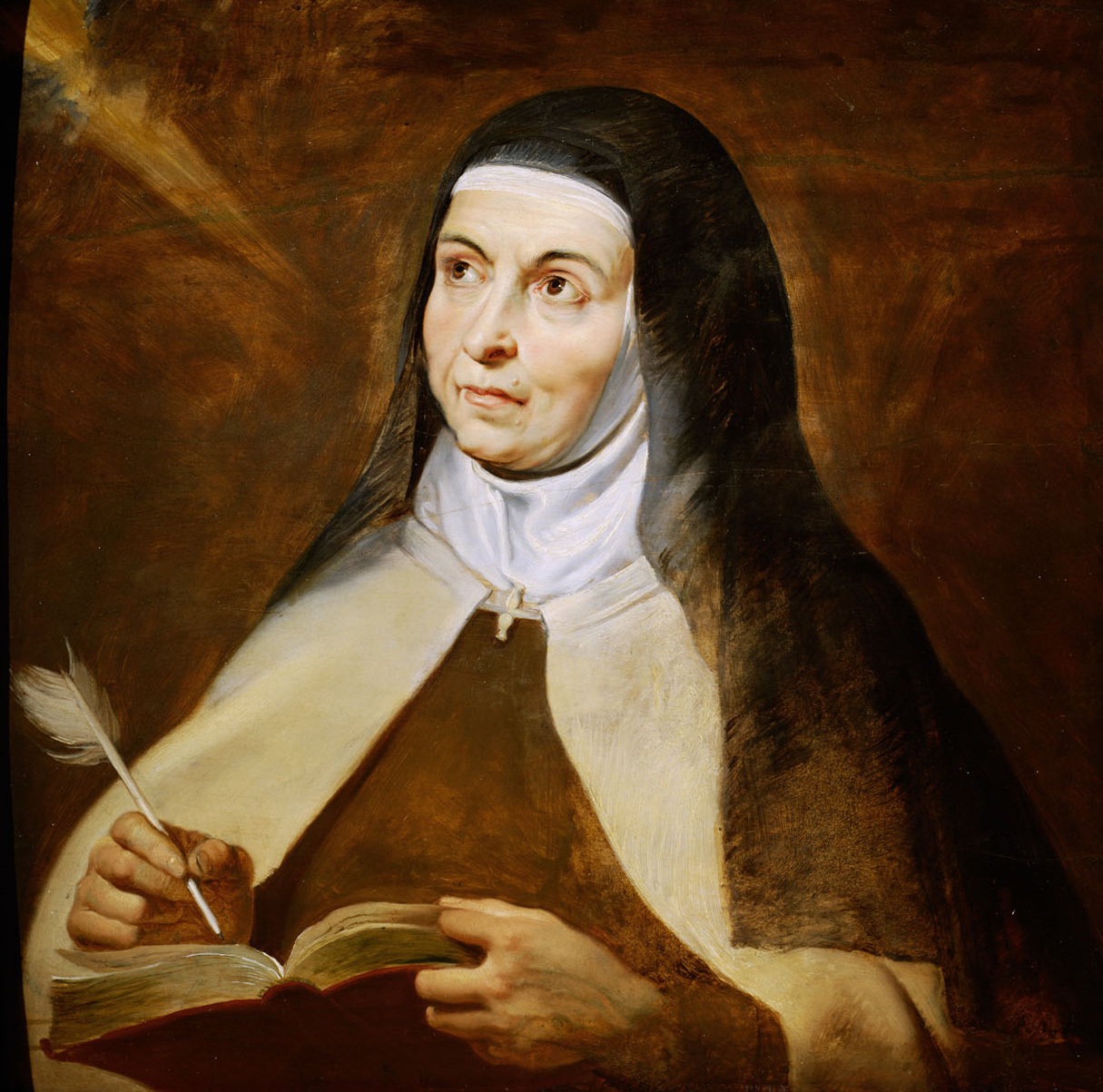
Image result for Teresa of AvilaTeresa of Avila was a 16th-century Carmelite nun and reformer in Spain. Saint Teresa was witty, sharp, intense, and austere. Yet, she was also deeply in love with Jesus Christ and wrote magnificent treatises on the Christian spiritual life. Due to her incredible faith and contributions to spiritual theology, Teresa of Avila was named one of only thirty-six "Doctors of the Church."

The following prayer, penned by Teresa, was found only after her death in 1582. She had written it down on a scrap of paper to use as a bookmark. May these simple-yet-profound words of trust in God alone sit deep within us this day:

Let nothing disturb you;                      Nada te turbe;
Let nothing frighten you.                    Nada te espante;
All things are passing.                        todo se pasa;
God never changes.                            Dios no se muda.
Patience obtains all things.                 La paciencia todo lo alcanza.
Those who have God,                        Quien a Dios tiene
are never lacking.                               nada le falta.
God alone suffices.                            Solo Dios basta.

Saturday, March 21, 2020

A Song of Hope

I've returned to blogging after a long hiatus. I didn't have much time to sit and collect my thoughts for this page, as I have been joyfully busy as a parish priest now for nearly two years. Of course, so much of the day-to-day ministry has come grinding to a near halt due to the Corona Virus pandemic. This time in quarantine has afforded me an opportunity to return to this page and share some thoughts of hope and faith during such an uncertain moment in the life of our world.

Really, the idea of blogging came to me today as I was praying Morning Prayer - which is part of the Liturgy of the Hours, the universal prayers of the Church which includes psalms, canticles, scripture passages, petitions, and reflections from various saints that are prayed daily by clerics, religious, and many lay faithful throughout the world.

Each Morning Prayer includes the Canticle of Zechariah (see Luke 1:68-79). This is the song that the father of John the Baptist belted out upon the birth, circumcision, and naming of his son. Zechariah praises and blesses the Lord for the liberation that God has offered to God's People. Zechariah then looks to his infant son John, and offers a prophecy of his mission as preparing the way for the Christ. Finally, in stunningly beautiful language, Zechariah prays: "In the tender compassion of our God, the dawn from on high shall break upon us, to shine on those who dwell in darkness and the shadow of death, and to guide our feet into the way of peace."

This daily prayer can become our own song of hope. Yes, even in the darkest night, we know that Jesus Christ, Light of the world, will usher in another dawn. We believe that Jesus Christ offers us a peace which the world cannot give. In Jesus Christ, we experience the very face of the Father's compassion and mercy. While the pall of death is ever-present, so is the life-saving and self-sacrificial work of doctors and nurses, modeled after Jesus the Divine Physician. Though now is the time of the cross, we believe that resurrection and new life will follow.

So my friends, let us make Zechariah's song our own. Let us not be robbed of hope.

Thursday, October 4, 2018

"Rebuild My Church"

It seems that the Church is collapsing all around us.

For decades, the number of people regularly worshiping and participating in their faith communities has plummeted. Ideology has displaced the role of theology. Values contrary to the gospel have crept into our Church. Most devastating of all, vulnerable children became victims of sexual abuse committed by clergy and their crimes were covered-up by ecclesiastical leaders.

In light of these troubling realities, it is worth reflecting on the call of Saint Francis of Assisi to give us guidance.

After years of partying, living extravagantly, and violent fighting, Francis began to journey back to the Christian faith. During this period of re-conversion, Francis lived more simply and generously.

Francis performed works of mercy.
He also began to pray more.

One day, as he prayed before the cross in the dilapidated ancient chapel of San Damiano, Francis heard a very distinct voice saying:
"Rebuild My Church!"

Initially, Francis believed that he was being summoned by God to rebuild the chapel of San Damiano, which he did brick by brick. However, the more Francis embraced the Gospel in his life, the more he realized that the Lord was actually calling him to rebuild the Church - not necessarily brick by brick - but rather person by person.

Throughout his life, Francis worked to rebuild the Church. While some in the Church marginalized the sick and suffering, Francis cleaned and kissed their wounds. While some in the Church acquired unbridled wealth, Francis embraced voluntary poverty. While some in the Church clung onto their individual power, Francis gathered together a community of brothers and sisters. While some in the Church became greedy, Francis lived peacefully alongside all of God's Creation. While some in the Church condemned sinners, Francis preached the good news of salvation. While some in the Church called for war with enemies, Francis risked his life to make peace.

San Damiano Crucifix
Person by person, Saint Francis helped to rebuild the Church in the 13th century.

You and I know the many, many problems facing our Church today. We know that so much needs to
be rebuilt. Right now, just as it happened 800 years ago, the crucified and risen Christ is speaking to our hearts from a place of ruin and decay. He is saying: "Rebuild My Church." 

We might be tempted to think we are not equipped for this mission, that we don't have the proper background, training, or education. But neither did Francis. However, Saint Francis did embrace the values of the Gospel: He was prayerful. He sought community. He preached. He lived simply and humbly. He listened. He acted. He loved.

If we are guided by the Spirit of God and the example of Francis, then you and I also can help rebuild the collapsing Church... person by person.

Tuesday, September 11, 2018

The Broken Body of Christ is Still Here

Last Wednesday, our parish community hosted an evening of silent prayer before the Eucharistic Lord. We described this prayer moment as "The Broken Body of Christ: A Time to Pray for the Victims of Child Sexual Abuse and Betrayal". The invitation to pray was extended to our parishioners as well as to the Christian faithful throughout the city of Scranton.

Through simple exposition of the Blessed Sacrament, a reading from 1 Corinthians 11:23-29, a brief reflection, and prayerful silence, we, the members of Christ's broken body, offered our prayers for healing for those members of the Body who were violated, sexually abused by clergy, and disregarded by ecclesiastical leaders.


The most profound moment in prayer for me came near the end of this time in silence. I recall looking around our spacious worship site. Though few members of the Body were present, what I did notice nevertheless filled me with great hope:

I noticed three married couples, spanning ten to fifty years together. 
I noticed several religious sisters, most with eyes closed in silent prayer.
I noticed the shrill laugh and scream of a young child echo through the church.
I noticed the tears on the cheeks of an older member of our community.
I noticed the Episcopalian priest and her intent gaze at the Eucharist.
I noticed the languages of Spanish and English spoken in the peoples' prayers.

I noticed that the Body of Christ, though broken, is still here.

Yes, we are the Broken Body of Christ. We continue to pray for the victims of child sexual abuse and betrayal. We pray for justice for the survivors of abuse and we pray for authentic reform of those structures that allowed this to happen. We pray that this Broken Body might one day be made whole again.

Christ is still here in this Broken Body. And this gives me hope.

Thursday, August 23, 2018

The Relevancy of God's Word

Yesterday's first reading from the prophet Ezekiel was immensely relevant to all that is transpiring in the Church. Yesterday's reading points to the utter moral failure of Israel's leaders to care for the people entrusted to them. Once again, we have witnessed this failure in moral leadership and guidance, this time by those Roman Catholic priests who abused children and those bishops who chose to hide these crimes.

And in God's providence, today's reading from Ezekiel offers a word of hope. It is God alone who is the true shepherd of God's people. God will transform our cold, deadened hearts - made so by the gravity of the sexual abuse crisis and the cover-up scandal - into living, loving hearts once again. It is through the tender compassion of our God that all who have been scattered will be re-gathered together and made whole again.

There is hope in the midst of the scandal of these crimes and sins. Our hope is in the Lord. We put our faith in the justice, the mercy, and the peace of God. It is God alone who gathers, God alone who heals, and God alone who transforms. In God, we put our trust.


Yesterday's first reading (Ezekiel 34:1-11):
The word of the Lord came to me:
Son of man, prophesy against the shepherds of Israel,
in these words prophesy to them to the shepherds:
Thus says the Lord GOD: Woe to the shepherds of Israel
who have been pasturing themselves!
Should not shepherds, rather, pasture sheep?
You have fed off their milk, worn their wool,
and slaughtered the fatlings,
but the sheep you have not pastured.
You did not strengthen the weak nor heal the sick
nor bind up the injured.
You did not bring back the strayed nor seek the lost,
but you lorded it over them harshly and brutally.
So they were scattered for the lack of a shepherd,
and became food for all the wild beasts.
My sheep were scattered
and wandered over all the mountains and high hills;
my sheep were scattered over the whole earth,
with no one to look after them or to search for them.

Therefore, shepherds, hear the word of the LORD:
As I live, says the Lord GOD,
because my sheep have been given over to pillage,
and because my sheep have become food for every wild beast,
for lack of a shepherd;
because my shepherds did not look after my sheep,
but pastured themselves and did not pasture my sheep;
because of this, shepherds, hear the word of the LORD:
Thus says the Lord GOD:
I swear I am coming against these shepherds.
I will claim my sheep from them
and put a stop to their shepherding my sheep
so that they may no longer pasture themselves.
I will save my sheep,
that they may no longer be food for their mouths.

For thus says the Lord GOD:
I myself will look after and tend my sheep.


Today's first reading (Ezekiel 36:23-28):
Thus says the LORD:
I will prove the holiness of my great name,
profaned among the nations,
in whose midst you have profaned it.
Thus the nations shall know that I am the LORD, says the Lord GOD,
when in their sight I prove my holiness through you.
For I will take you away from among the nations,
gather you from all the foreign lands,
and bring you back to your own land.
I will sprinkle clean water upon you
to cleanse you from all your impurities,
and from all your idols I will cleanse you.
I will give you a new heart and place a new spirit within you,
taking from your bodies your stony hearts
and giving you natural hearts.
I will put my spirit within you and make you live by my statutes,
careful to observe my decrees.
You shall live in the land I gave your ancestors;
you shall be my people, and I will be your God.

Tuesday, August 21, 2018

Jesus Descends Into Hell

Last week's release of the Pennsylvania Grand Jury Report regarding the sexual abuse of at least 1,000 children (it is so painful to even write that number) by 300 Roman Catholic priests and its subsequent cover-up by bishops and other Church officials in Pennsylvania has been nothing short of devastating, particularly for the survivors of sexual abuse.

These victims were innocent children who were preyed upon in terrible ways. And then, their horrific ordeal was silenced by bishops and other officials. I cannot even begin to imagine the pain and struggle endured by these survivors. They are brave and they have waited a very long time for justice. I pray that they might begin to experience healing and hope.

It was also devastating for many Catholics - laity and priests alike. Those of us who depend upon our faith, no matter how weak it may be at times, have been shaken by the findings of the Grand Jury: How could a priest commit such a grievous crime against a child? Why did our bishops move those priests accused of sexual abuse from parish to parish? Why did they continue to put children in harm's way? Our hearts are broken for those who endured such suffering. And we want justice and accountability from our leaders... now!

In the midst of this swirl of emotions - anger, frustration, deep sadness, and devastation - I celebrated the Sunday Eucharist with my parish community, just as I have been doing every Sunday since my arrival at the parish two months ago. And just as we have done every Sunday, we professed the Apostles' Creed. However, unlike all other previous Masses, one line in particular from the Creed grabbed my attention in a new way: "He descended into hell."

As Catholic-Christians, we believe that Jesus was crucified, died, and was buried. But the story of Jesus' suffering does not stop there. As if this suffering of Jesus was not enough, he then enters into the very realm of the dead. Jesus goes to the place of no hope. Jesus enters the places of emptiness, of pain, of betrayal, of lies and darkness. Jesus journeys to that pit of devastation. 

There, in hell, Jesus finds all those who suffer, those who have been harmed, those who have been neglected, forgotten, and silenced. Jesus descends into their personal hells, not of their own creation, but imposed on them. Jesus descends into hell in order to seek out all who suffer. Jesus finds each and every hell where there is pain, suffering, and death. Jesus descends into hell so that he can rise again. Jesus does not rise, however, until he has entered each personal hell and lifts up all those who have died a thousand deaths inflicted on them by their abusers and those who covered up these crimes. 

No word, no promise, no program, no amount of support, counseling, and assistance will ever be able to blot away the devastation of child sexual abuse and its subsequent cover-up by Catholic clergymen. There is no quick fix for them. It is a lifetime of suffering. Many of the victims continue to experience hellish pain and ongoing trauma.

Abusive priests and bishops who abused their authority imposed this hell on thousands of victims.
And so, Jesus descends into hell.

Tuesday, July 10, 2018

"He is Our Priest"

Last weekend, I was honored to preside at the Marriage Liturgy and witness the exchange of vows of my brother and sister-in-law. After the ceremony, the bridal party was subjected to a barrage of photos. When the photographer saw me join in the photos, he asked the bride how I was related to her.

"Ryan is the brother of the groom. But he is also our priest."


He is our priest. This phrase captures for me the experience thus far of being ordained a priest and serving the People of God in the local Church of Scranton. This phrase points to the joy I've felt in being able to be a priest with and for others. There have been so many moments of grace, laughter, love, and peace during my brief time in this particular ministry. It is overwhelming, in the best sense of the word!

He is our priest. This phrase is also a challenge to me. It is a reminder that I must always remain close to others. It is an invitation to patiently journey alongside fellow Christians, with men and women of other faiths, and with non-believers. It means I am called to be selfless in my ministry and to collaborate with other ministers, especially lay and religious. I am summoned to be a priest for others, to love without conditions, and to serve the needs of the poor and the suffering.

He is our priest. This will always remain true, as long as I follow the gentle and compassionate ways of our High Priest: Jesus Christ!

Monday, May 14, 2018

Chosen in Different Ways

As the legend goes, a pastor of the inner-city St. Matthias Parish received a complaint from a disgruntled parishioner about the parish's upcoming summer festival, which included raffles and small games of chance. The parishioner barked out: "How dare the Church participate in such activities!" With a tinkle in his eye, the old priest responded: "Sir, the namesake of our parish was chosen by a game of chance. I think we'll be just fine."

Saint Matthias: Apostle 
I'm not sure the veracity of the above-mentioned story. However, what is true is the fact that Saint Matthias was indeed chosen by casting lots to replace the deceased Judas Iscariot. The remaining eleven apostles felt called to replace Judas with somebody who had followed Jesus from the beginning of his ministry. And not only that, the apostles wanted this twelfth member to have experienced and witnessed the resurrection of Jesus Christ.

From this criteria, two men were nominated: Justus and Matthias. Ultimately, after a brief prayer and the drawing of lots, Matthias was chosen as Judas' replacement.

On this feast of the apostle Matthias, we celebrate his role as witness, apostle, and martyr. We also recall on this day that our Christian faith is not limited and confined to one historical moment or one specific group. Rather, faith in the resurrection of Christ is always handed on to each succeeding generation.

Still, there is always one last detail that seems to be glossed over on this feast day: what about Justus? We don't hear much about him after his second-place finish to Matthias. But maybe that's exactly the point.

Even though Justus was not given a place of apostolic leadership, we can presume that he nevertheless continued with his principle ministry of preaching faith in Christ Jesus. Even though Justus may have experienced some embarrassment of not being chosen as apostle, he still remained faithful to Christ. Justus did not focus on himself, but on his mission of sharing the good news of the crucified and risen Lord.

Saint Justus: Chosen Not to Lead, but to Witness to Christ

There is a lesson in this for us. We may be passed over for positions of leadership or we might find ourselves embarrassed at the prospect of a second-place finish. But our dignity as Christians does not rest solely in positions of authority nor in our success. What is most important is our faithfulness, that we who have personally experienced the love of the Risen Lord Jesus share this encounter with others. All of us who have been baptized are called to this mission of evangelical love.

We may not be chosen to lead like the apostles, but all of us like Matthias and Justus have been chosen to be witnesses to the grace, the power, and the electric love of the resurrection of Christ Jesus.

Saint Matthias, Apostle and Saint Justus, not-Apostle, pray for us!

Tuesday, February 27, 2018

Faith and Humility

In his Second Letter to Timothy, Paul reminded his pupil Timothy about the faith example of his mother and grandmother:
"I yearn to see you again, recalling your tears, so that I may be filled with joy, as I recall your sincere faith that first lived in your grandmother Lois and in your mother Eunice and that I am confident lives also in you." 
(2 Timothy 1:4-5)

Just today, I read a reflection on today's Gospel passage written by my mom, Maria, which was sent through the Office of Alumni Relations at King's College.

Her beautiful and humble faith is on full display in her composition. It is a faith that I was blessed to experience while growing up. Her faith shaped my own understanding of God. And hers is a faith that continues to inspire me.

I share her reflection on the virtue of humility as found in today's Gospel from Matthew 23:1-12:
https://www.kingsalumni.info/controls/email_marketing/admin/email_marketing_email_viewer.aspx?sid=73&eiid=1723&seiid=1413&usearchive=1&puid=f73db210-bdce-46ad-a9dc-360c7f805d8e

Monday, January 22, 2018

Driving Directions

Earlier this month, I was driving out to the Midwest with my friend Kayla. We had been asked by our friends to serve as the godparents to their son. In my hasty preparation for the lengthy drive, I mistakenly plugged in the wrong address into the GPS. Actually, I typed an entirely different state into the GPS. (Though in my defense, both state's have a town with the exact same name!)
For most of the ride, we were directed toward Missouri and not Illinois, where our friends live.

After hearing me endlessly blabber on about crossing the Mississippi River and nearing the city of St. Louis, Kayla gently challenged me to look again at the address. Sure enough, it was incorrect. We were supposed to be arriving to our friends' house in Illinois, not Missouri. Thankfully, Kayla noticed my mistake while we were passing through Illinois. If she had waited any longer to point out my misstep, we potentially would have driven an two additional hours past our actual place of arrival.

(Trust me, I took a lot of flack for this navigation snafu from my friends!)

I recount this story not only for a chuckle at my expense, but primarily because had I not listened to Kayla and went in a different direction, I would have totally missed the destination of my Midwest journey. This experience during my road trip reminds me of yesterday's Gospel passage in which we hear Jesus begin his public ministry with these words, "Repent, and believe in the Gospel!" Perhaps put another way, Jesus is saying, "Check your location, and go in a different direction!"


All of us - whether seasoned Christians or neophytes - are in need of constant conversion and transformation. As human beings, it is our natural inclination to wander from the ways of love and traverse the roads of sin. Sometimes, even our best intentions can lead us down a rocky path. We can quickly become lost.

And so we need to hear that gentle, but firm voice of Jesus, challenging us to look at the direction we are currently taking in our lives: Where am I right now and where am I going? What map am I following? We are challenged to listen carefully to that voice of Jesus, to that good friend who speaks up when we are moving in the wrong direction, and return to the right path. In doing so, we will experience true and lasting peace, an abiding sense of joy in our lives, and we will arrive safely at our destination: life in God.

Saturday, January 20, 2018

If We Are Pro-Life...

Yesterday was the 45th annual March for Life in Washington, D.C. Thousands of peaceful protesters, many of whom were Christians, gathered in the nation's capital to rally and march in support of the rights of unborn children, hoping to call attention to the injustices that have emerged from the Supreme Court's 1973 decision in Roe v. Wade.

Certainly, being pro-life means opposing the practice of abortion. As people of faith, we recognize the awesome gift of life that God has given to each one of us.

In the 1980's, Cardinal Joseph Bernardin of Chicago advocated for an integrated vision to all life issues. He called this approach the "seamless garment of life," based on the Gospel values of life and the teachings of the Church. Each issue is, in some way, tied to the other. As Christians, we are challenged to be fully "pro-life."

  • If we are pro-life, we are to oppose those conditions which often lead expectant mothers to choose to terminate their pregnancies, especially poverty and lack of support.
  • If we are pro-life, we must support life in all its stages. To be authentically pro-life means we advocate for healthcare for all. To be pro-life is also to provide educational and work opportunities for people across the spectrum. 
  • If we are pro-life, we honor those nearing the end of life. We oppose euthanasia and physician assisted suicide. Life is hallowed, even at its natural end.
  • If we are pro-life, we will make sure that the poor, the elderly, and those on the margins for whatever reason will have meals to eat and a roof over their heads. 
  • If we are pro-life, we oppose violence in all its forms. 
  • If we are pro-life, we oppose the death penalty. We will realize that capital punishment is often based in revenge, not true justice. 
  • If we are pro-life, we will reject war. And we reject any language which heightens conflict between peoples and nations.
  • If we are pro-life, we will never discriminate against any person based on their race, religion, or sexual orientation. To be pro-life is to reject racism, xenophobia, and homophobia.
  • If we are pro-life, we advocate for families. We want to see families thrive, especially immigrant and refugee families who are escaping the violence, oppression, and economic stagnation of their homelands in order to have a better life. 
  • If we are pro-life, then we are also to be pro-immigrant and pro-refugee.
  • If we are pro-life, we are also pro-woman. We oppose human trafficking. We oppose the business of sex slavery, including pornography. We must also advocate for equal standards of pay, treatment, and safety in the workplace. 
  • If we are pro-life, we will protect the vulnerable and fragile environment. We need to recognize the earth as a gift upon which all human life exists.

As Christians, we must strive to be authentically pro-life in all these areas. As the Church, we must not allow ourselves to be hijacked and co-opted by any one particular politician or party on these life issues. Neither the Republican party nor the Democratic party embodies the entirety of this "seamless garment." 

There is much work for us to do in our society to promote life and oppose practices which diminish human dignity. Each one of us will constantly need to be open to transformation and conversion regarding all of these life issues. We may need to gradually grow to embrace some of these pro-life stances and recognize the ways in which we might be violating God's command to protect human life in all its forms and stages.

We entrust our lives and our advocacy for life in all its forms to our Lord Jesus Christ who came so that we all might have life, and have it in abundance.